


5 high impact and easy ways to speed up marking.
There has been so much said recently on Twitter about marking and feedback mostly because Ofsted recently said that “there is remarkably little high quality, relevant research evidence to suggest that detailed or extensive marking has any significant impact on pupils’ learning” in a myth busting document published at the end of November. Marking has always been a contentious discussion in the 15 years I’ve been teaching … Continue reading 5 high impact and easy ways to speed up marking.

Model Key Stage 3 Curriculum
So, this is my model Key Stage 3 curriculum. It feeds into the new GCSE content in a broad way, but allows the students to have a thorough understanding of both the basic terminology and the chronology of theatre. As a school we’ve been looking at a knowledge based curriculum, and for all it’s good and bad points, there are a few things that can … Continue reading Model Key Stage 3 Curriculum

10 Fundamental Key Terminology for Greek Theatre
Protagonist: The leading character in a story Antagonist: The leading villain of a story Tragedy: A play dealing with tragic events and having an unhappy ending, especially one concerning the downfall of the main character Comedy: A play characterized by its humorous or satirical tone and its depiction of amusing people or incidents, in which the characters ultimately triumph over adversity. In Greek Theatre Comedy … Continue reading 10 Fundamental Key Terminology for Greek Theatre
20 Facts About Greek Theatre
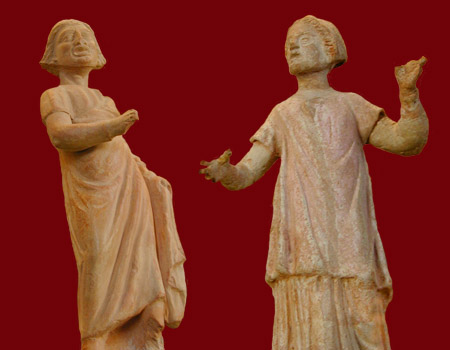
Image: http://www.vroma.org/images/mcmanus_images/actors.jpg The Ancient Greek drama, is a theatrical culture that flourished in ancient Greece from c. 700 BC. Athens Drama Festival originated from the Great Dionysia, a festival where people would take part in performances that explored great issues in their society. The earliest tragedy that survives, is Aeschylus Persai, dates from 472 The festivals were attended by all Athenian citizens (women as well … Continue reading 20 Facts About Greek Theatre
Two by Jim Cartwright
This was a play I was introduced to at a teacher conference several years ago by someone who said it was a brilliant GCSE text. They said it was brilliant, that it had revolutionised their approach to text based performances and had got excellent marks for it. To be honest it was the last bit about excellent marks that got me interested it in! It … Continue reading Two by Jim Cartwright

Knowledge Based Curriculum: Finding the balance
Returning to the idea finding a balance within the curriculum, I think that there needs to be a balance between knowledge and skills and I think that my previous schemes of work have probably been too focused on skills. There is no doubt in my mind that with the content requirements of the new GCSEs being so high, an increased knowledge of key terminology, concepts and … Continue reading Knowledge Based Curriculum: Finding the balance
 BURT'S DRAMA